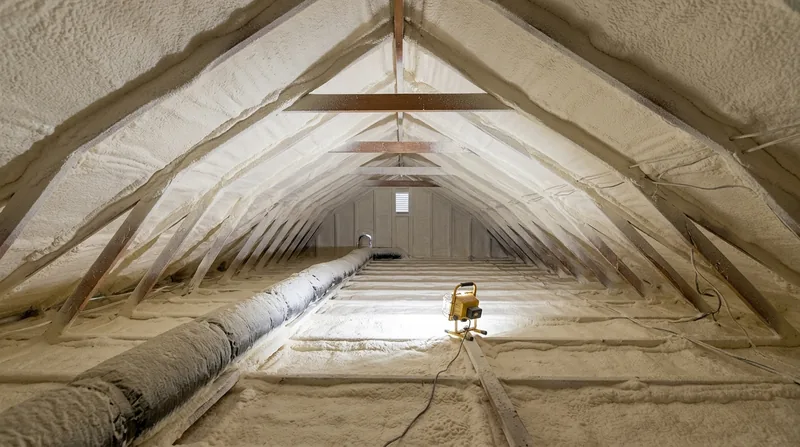




Attic spray foam insulation in Cleveland transforms an unfinished attic into conditioned, usable space while sealing the air leaks that plague older homes across the city. Cleveland's lake-effect winters and humid summers create a perfect storm for attic failure: ice dams pile up under heavy snow, summer heat bakes through fiberglass that has settled over forty years, and moisture drives both directions through poorly sealed assemblies. Open-cell foam on the roof deck stops the leak path entirely, keeps ductwork inside the thermal envelope, and turns a freezing knee-wall bedroom or a sweltering storage zone into square footage you can actually use. We spray to a measured R-value and thickness, pull mechanical ventilation during cure, and leave you with a written estimate that names exactly what you are paying for.
Why Attic Spray Foam Insulation Matters in Cleveland's Lake-Effect Climate
Cleveland sits on the south shore of Lake Erie, and that water shapes every attic problem in the region. Winter winds off the lake drive cold through every unsealed rim and joist; lake-effect snow piles feet deep east of the city and creates ice dams where warm attics meet uninsulated eaves. Summer humidity flips the vapor drive, and fiberglass that has been wet for months does not dry. A balloon-frame double in Ohio City or Tremont built in 1910 has almost no attic ventilation and no air barrier between the two flats; a 1950s ranch in Parma has a flattened original fill that has lost half its R-value; a 1980s colonial in Westlake or Hudson has ductwork in an unconditioned attic that sweats in spring and freezes in winter. Spray foam fixes all three by stopping the air leak, moving the thermal boundary to the roof deck, and keeping the ductwork inside the conditioned space.
- Sealed roof decks stop warm house air from leaking into the attic, so the attic stays close to indoor temperature all winter and the heat you pay for stays downstairs.
- Conditioned attics keep HVAC ducts, wiring, and plumbing inside the envelope, eliminating the energy loss that makes baseboard heating and air conditioning run all winter and summer.
- Controlled air sealing at rim joists, band joists, and the top plate stops the stack effect that pulls cold air into living spaces and drives heating costs up 20 to 30 percent in uninsulated basements.
- Moisture control on sealed decks prevents the wet-fiberglass failure mode that dominates older attics across the Heights and inner suburbs, where humid air enters through rim joists and condenses under cold roofs.
Each of these failures is addressable only by spray foam or a complete attic rebuild with mechanical ventilation and air barriers, and foam is the faster, more cost-effective path for the homes that dominate the Cleveland market.
Key info: A 1920s Tudor in Shaker Heights with a full third-floor attic under slate loses 40 percent of its winter heat through the roof deck and rim joists. Spray foam to R-38 on the deck and R-19 in the rim brings that loss down to 8 percent and qualifies the home for the federal energy efficiency tax credit. We deliver a written estimate that names the R-value, the thickness per pass, and the board footage before we spray a single pass.
For more detail on how closed-cell and open-cell foam differ in performance and cost, see our guide to closed-cell spray foam insulation and open-cell spray foam insulation in Cleveland.
How We Spray Attic Foam: The Process from Estimate to Finished Job
Attic spray foam starts with a written estimate that specifies the R-value target, the thickness per pass, and the total board footage. We measure the roof deck, identify air leaks around rim joists, band joists, and penetrations, and recommend the foam type (open-cell or closed-cell) based on your attic's current condition, your ventilation needs, and your budget. Once you approve the estimate, we set up mechanical ventilation, control the spray temperature and drum ratio, apply foam in thin passes to prevent shrinkage and voids, and maintain a re-entry window of 24 to 48 hours before you occupy the space. Every job includes a final walkthrough where we show you the coverage, the thickness, and the sealed penetrations.
- We inspect the attic for active moisture, leaks, or contamination, and we walk away if the roof or rim is wet or the substrate is compromised, because foam does not fix water; we fix the moisture first or we do not spray.
- We identify all air leaks: rim joists, band joists, plumbing penetrations, electrical chases, soffit returns, and any bypasses from the living space into the attic.
- We measure the roof deck square footage and calculate the board footage needed to reach your R-value target, accounting for the thickness per pass and the density of the foam type you choose.
- We spray in controlled passes, maintaining the manufacturer ratio and drum temperature, and we pull mechanical ventilation during cure to control VOC and ensure safe re-entry.
- We document the finished job with a photo walkthrough and a summary that names the R-value achieved, the average thickness, and the board footage sprayed.
This process takes one to three days depending on attic size and complexity, and the foam cures in 24 to 48 hours before you can move furniture or close the access hatch.
Example: A 1,200-square-foot attic in Lakewood with a sealed roof deck target of R-38 and rim joist insulation to R-19 requires roughly 35 to 45 board feet of closed-cell foam on the deck plus 8 to 10 board feet on the rim. The job takes two days. We set up intake and exhaust fans, spray the deck in two passes (1.5 inches per pass to avoid shrinkage), spray the rim in one pass, and pull ventilation for 24 hours. You re-enter the attic on day three.
For details on how we handle insulation removal before a new spray foam installation, see our insulation removal service page.
Attic Spray Foam Insulation Methods: Open-Cell vs. Closed-Cell
| Foam Type | R-Value per Inch | Best for Cleveland Attics | Cost Range |
|---|---|---|---|
| Open-Cell | 3.5 to 3.8 | Attic spray foam where ventilation is planned, sound dampening, and budget-conscious jobs on sealed decks with no moisture risk. | Starting at $1.50/sq ft |
| Closed-Cell | 6.0 to 6.5 | Attics with existing moisture, rim joists exposed to lake-effect wind, sealed roof decks where R-value must be high in thin space, and basements with water risk. | Starting at $2.00/sq ft |
| Hybrid (Closed-Cell Rim + Open-Cell Deck) | Closed 6.0, Open 3.5 to 3.8 | Attics where rim and band joists need moisture barrier and condensation control, but the roof deck can be ventilated or is low-risk. | Starting at $1.75/sq ft average |
| Removal + Re-Insulation | Varies by new foam choice | Attics with failed fiberglass, settled or wet insulation, or previous spray foam that did not cure properly. | On estimate |
Open-cell foam is less dense, lower cost, and breathable, making it ideal for attics where air movement is planned or where budget is the primary driver. Closed-cell foam is denser, higher R-value per inch, and acts as a vapor barrier, making it the right choice for rim joists in lake-effect wind zones and for sealed decks where moisture control matters. Many Cleveland attics benefit from a hybrid approach: closed-cell on the rim and band joists to stop wind-driven rain and condensation, and open-cell on the roof deck to reduce cost and allow controlled ventilation if needed.
Attic Spray Foam Insulation Cost in Cleveland: What to Expect
Attic spray foam insulation in Cleveland starts at $1.50 per square foot for open-cell foam on a straightforward roof deck with good access and no moisture issues. Closed-cell foam runs $2.00 to $2.50 per square foot because it delivers higher R-value per inch and provides a vapor barrier that matters in humid climates. A typical 1,200-square-foot attic with a sealed roof deck target of R-38 costs $1,800 to $2,400 for open-cell, or $2,400 to $3,000 for closed-cell. If the attic has existing insulation that needs removal, add $0.50 to $1.00 per square foot for haul-away and disposal. Rim joist and band joist insulation runs $8 to $12 per linear foot, depending on the width and height of the joist and whether moisture remediation is needed first.
The biggest variables that move cost are:
- Access to the attic: a pull-down ladder and a clear floor plan cost less than a tight hatch or a three-story climb through a finished home.
- Existing insulation: removing settled fiberglass or failed foam adds time and disposal cost.
- Moisture or contamination: if the attic is wet or the substrate is compromised, we remediate first or we walk away, which extends the job and the cost.
- Roof complexity: a simple gable roof is faster than a hip roof with dormers and multiple valleys.
- R-value target: R-38 on a flat deck is cheaper than R-50 or R-60 if space allows, because higher R-values require thicker foam.
The best way to understand your cost is to request a free written estimate. We measure your attic, identify the foam type and thickness needed to hit your R-value target, and give you a firm number before we spray. Most estimates come back within 24 hours at (216) 465-0804.
Real example: A 1,500-square-foot attic in Cleveland Heights with an existing layer of settled fiberglass, a sealed roof deck target of R-40, and closed-cell foam on the rim joist runs $3,200 to $3,800. That includes removal of the old insulation, disposal, foam on the deck and rim, mechanical ventilation during cure, and a written summary of the R-value and thickness achieved. A simpler open-cell job on the same attic without removal would run $2,200 to $2,600.
Attic Spray Foam Insulation Near Me: What Cleveland Homeowners Should Know When Hiring a Contractor
Hiring the right spray foam insulation contractor is the difference between a job that solves your attic problem and a job that creates new ones. The spray foam trade attracts two types of operator: rig-and-run crews in out-of-state trailers who spray an attic in an afternoon and disappear when the smell will not go away or the foam cures poorly, and national franchises that charge premium prices and send rotating crews. A local independent shop with a local address and local plates is positioned against both because reputation matters when you live and work in the same town.
When you call a spray foam contractor, ask these questions:
- Does the estimate include the R-value target, the thickness per pass, and the total board footage, or is it just a price per square foot with no technical detail?
- Will the contractor pull mechanical ventilation during cure, or are they promising immediate re-entry and a dry-to-touch finish in hours?
- Can they show you proof of current general liability insurance and name the coverage limit and the policy holder?
- Do they handle insulation removal themselves, or do they subcontract it out and add markup?
- If your attic has active moisture or a leaking roof, will they fix the source first, or will they spray over wet substrate?
- Do they know the local building code requirements for your city, including thermal barriers, ignition barriers, and attic ventilation rules?
If a contractor cannot answer these questions clearly, or if their estimate has no R-value and no thickness, walk away. Spray foam is not a commodity, and a price without specification is the clearest marker of an installer who does not know their own work.
For more detail on how to evaluate any spray foam contractor, see our air sealing service page, which covers the technical standards that separate a professional job from a rig-and-run. If you are ready to move forward, contact us for a free estimate or call (216) 465-0804.
Attic Spray Foam Insulation in Cleveland: Pricing Guide
| Service | Price | Details |
|---|---|---|
| Open-Cell Attic Spray Foam | Starting at $1.50/sq ft | Straightforward roof deck with good access, no moisture issues, and ventilation planned or acceptable |
| Closed-Cell Attic Spray Foam | Starting at $2.00/sq ft | Moisture control needed, sealed roof deck, or rim joist insulation in lake-effect wind zones |
| Rim Joist and Band Joist Insulation | Starting at $8.00/linear foot | Closed-cell foam on rim and band joists to stop wind-driven rain and condensation in basement or crawl space |
| Insulation Removal and Re-Insulation | On estimate | Existing fiberglass or failed foam removal, haul-away, and new spray foam installation, cost varies by volume and contamination |
| Travel and Setup | Included | No separate mileage or call-out fee within Cleveland and surrounding service areas |
| Written Estimate | Free | Response within 24 hours, includes R-value target, thickness per pass, board footage, and firm price before work begins |
Indicative pricing, the exact cost depends on square footage, finish, and site access. Free personalized estimate within 24h at (216) 465-0804.


