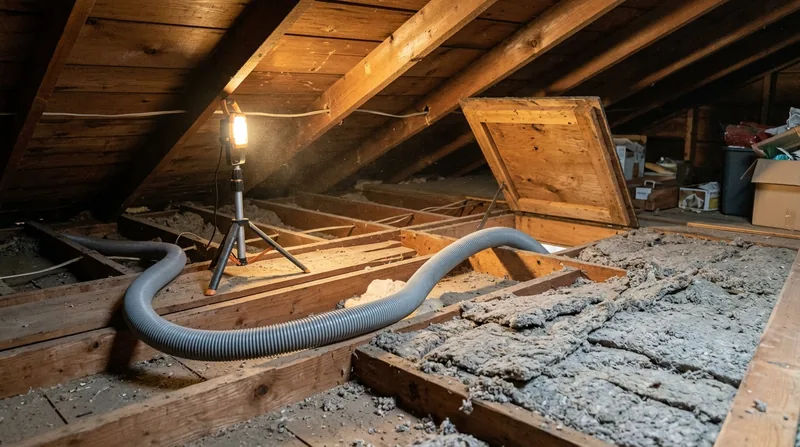




Cleveland's oldest homes pack insulation problems into tight attics and crawl spaces that bake under July heat and freeze under lake-effect snow every winter. Insulation removal in Cleveland means pulling out decades of settled fiberglass, rotted batts, and failed spray foam before any retrofit can begin. The city's 1900s balloon-framed doubles in Ohio City and Tremont, the slate-roofed Tudors of Cleveland Heights and Shaker Heights, and the 1940s brick bungalows of Parma all sit on basements where moisture and ice dams have driven insulation into failure. We remove old fiberglass and cellulose, leave any suspected vermiculite untouched for testing by a licensed professional, cut out bad foam, and leave a clean substrate for new spray foam or air sealing. Removal is not glamorous work, but it is the foundation of every insulation retrofit that actually works.
Why Insulation Removal Matters in Greater Cleveland
Old insulation fails in predictable ways. Blown-in fiberglass settles over decades, compressing from its original R-value into a fraction of its rated performance. Batts shift, sag, and leave gaps along rim joists and band joists where cold air pours in. Spray foam installed without proper ventilation during cure traps moisture, develops odor, and sometimes never hardens fully. In Cleveland, where the lake drives winter wind and summer humidity flips the vapor drive twice a year, a failed insulation layer is not a small problem. It bleeds heat, it rots wood, and it costs money every month.
- We vacuum out settled blown-in insulation and remove old batts without disturbing the attic structure or leaving debris behind.
- We identify and flag vermiculite insulation for professional testing before any work proceeds, never disturbing it ourselves.
- We cut out failed spray foam installations that other contractors will not touch, leaving a clean surface for a new system.
- We inspect the substrate for moisture, rot, or roof leaks and will not spray over a wet or compromised surface.
Removal done right is the precondition of every retrofit that performs. Without it, you are spraying over a failing foundation.
Cleveland context: Older attics in Collinwood, Slavic Village, and Detroit-Shoreway often hold original blown-in from the 1970s or 1980s, now compressed to half its R-value. Lakewood and Cleveland Heights homes under slate roofs frequently show moisture damage in the third-floor attic. Removal exposes what is really happening up there.
For more on what comes after removal, see our attic spray foam insulation service page.
The Ohio Building Code and local building departments govern what can be left behind and how. Always verify permit and contractor registration requirements with your city before work starts. For Cleveland, contact the City of Cleveland Building and Housing Department or your local jurisdiction.
How We Remove Insulation in Cleveland: Step by Step
Removal is systematic. We set up containment to keep dust and debris from spreading into living space, then vacuum or hand-remove the old material into sealed bags. Vermiculite gets flagged and left untouched. Failed foam is cut out by hand or with power tools, depending on thickness and adhesion. The attic or wall cavity is then inspected for moisture, rot, or structural damage before any new work is quoted. Speed matters less than thoroughness. A rushed removal job leaves debris in hidden spaces and makes the next layer fail.
- We inspect the space and identify the type of insulation, any moisture damage, and the condition of the substrate.
- We set up containment barriers and mechanical ventilation to control dust and odor during removal.
- We vacuum out blown-in insulation or hand-remove batts, bagging material for proper disposal.
- We flag any vermiculite and leave it in place, documenting its location for the homeowner.
- We cut out failed spray foam using hand tools or power equipment, removing all debris and loose material.
- We inspect the exposed surface for moisture, rot, or roof leaks and report findings before proceeding with new insulation.
Once the old material is gone and the substrate is verified dry and sound, you have a clean foundation for a new system.
Real example: A 1920s double in Tremont with original blown-in and two failed spray foam patches. We removed all the old insulation, flagged the vermiculite for testing, cut out the foam, and exposed water staining on the roof deck. The homeowner called a roofer, fixed the leak, and then we sealed and sprayed the attic with closed cell. That sequence is the only one that works.
For the next step, explore closed cell spray foam insulation or open cell spray foam insulation depending on your climate control needs.
Removal Methods and Equipment
| Method | Description | Best For |
|---|---|---|
| Vacuum extraction | Mechanical suction with HEPA filtration removes blown-in insulation into sealed bags with minimal dust escape. | Settled fiberglass, cellulose, or mineral fiber in attics and wall cavities. |
| Hand removal | Batts and rolls are manually pulled and bagged, allowing inspection of every cavity and sealing of gaps as work proceeds. | Batt or roll insulation in attics, walls, or rim joists where access is good and precision matters. |
| Foam removal | Power tools or hand saws cut out failed spray foam in sections, exposing substrate for inspection and new installation. | Failed closed cell or open cell foam, or foam installed without proper ratio or ventilation. |
| Vermiculite flagging | Insulation is identified and documented in place without disturbance, marked for professional asbestos testing if needed. | Older Cleveland attics with original vermiculite from 1960s through 1980s installations. |
Insulation Removal Cost in Cleveland: What to Expect
Removal pricing depends on the volume of insulation, the type of material, substrate access, and whether failed foam must be cut out. A straightforward attic with settled blown-in runs lower; a job with multiple failed foam patches or difficult crawl space access runs higher. We always measure on site and give you a written estimate with R-value and thickness specs before work starts. Most attics in Cleveland run from $950 to $2,500 depending on square footage and complexity. Crawl spaces and wall cavities are estimated separately because access and removal method vary widely. Get full pricing details here, or call (216) 465-0804 for a free estimate.
Do not choose a contractor based on the lowest removal quote. A cheap removal that leaves debris, does not inspect for moisture, or buries vermiculite will cost you thousands in failed insulation later. The best estimate is the one that includes an inspection report, specifies what happens to old material, and names what happens next.
What to Look for When Hiring an Insulation Removal Contractor Near Me in Cleveland
Hiring the right removal contractor sets up everything that follows. You want someone who inspects before quoting, who flags vermiculite instead of disturbing it, who removes failed foam instead of ignoring it, and who will walk away if the substrate is wet or compromised. Ask for an estimate that includes what material will be removed, how it will be disposed of, whether the substrate will be inspected, and what the next step is. Call references and ask specifically about the condition of the attic after removal and whether moisture or structural issues were caught. Verify that your contractor is fully insured and that coverage applies to insulation work. Check with your local building department about whether removal requires a permit at your address (some cities require it, some do not), and if it does, confirm that the contractor will help you navigate it.
- Ask for a written estimate that specifies the removal method, disposal plan, and substrate inspection scope.
- Request references from recent attic or crawl space removal jobs and ask about the condition of the space afterward.
- Verify that the contractor is fully insured with coverage that names insulation and spray foam work.
- Confirm that vermiculite will be flagged and left untouched, not vacuumed up or disturbed.
- Ask whether a permit is required at your address and who handles the application and inspection.
- Get a timeline and understand whether the job can proceed immediately or if the space needs to dry out first.
The right contractor will tell you if removal alone is not enough and what comes next. That honesty is the mark of a professional.
Red flags: An estimate with no R-value spec, no mention of substrate inspection, a price far below market, no insurance verification, or a promise of immediate re-entry without ventilation. These are the markers of a rig-and-run crew or a franchise that prioritizes speed over quality. Any contractor worth hiring will take time to do the job right.
Ready to get started? Contact us for a free estimate or call (216) 465-0804. We serve Cleveland, Lakewood, Parma, Cleveland Heights, Shaker Heights, and all of Greater Cleveland.
Insulation Removal in Cleveland: Pricing Guide
| Service | Price | Details |
|---|---|---|
| Attic blown-in removal | Starting at $950 | Vacuum extraction of settled fiberglass or mineral fiber, bagging and disposal included, up to 500 sq ft attic space |
| Failed spray foam removal | Starting at $1,200 | Hand or power tool cutting and removal of closed cell or open cell foam, substrate inspection, disposal, area-dependent pricing |
| Crawl space insulation removal | Starting at $1,400 | Removal of batts, blown-in, or foam from crawl spaces; access and moisture conditions are primary cost drivers |
| Multi-room or complex removal | On estimate | Jobs spanning multiple attics, walls, or large crawl spaces; site inspection required before pricing |
| Travel | Included | No separate mileage or travel fee within Cleveland and surrounding service areas |
| Free estimate | No obligation | Written estimate with R-value and thickness specs, response within 24 hours at (216) 465-0804 |
Indicative pricing, the exact cost depends on square footage, finish, and site access. Free personalized estimate within 24h at (216) 465-0804.


