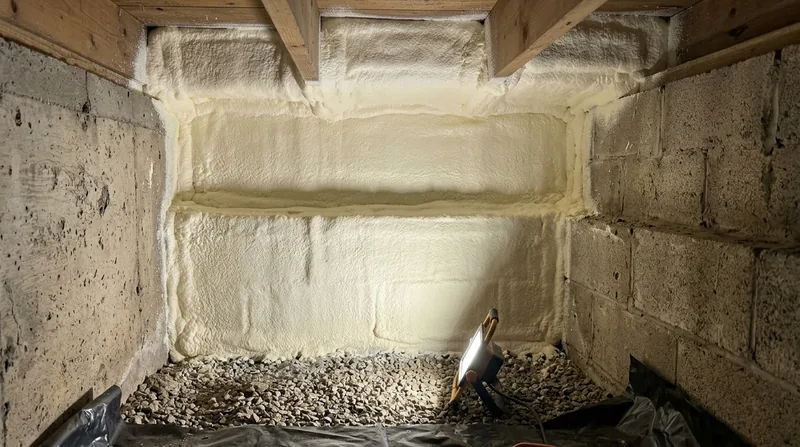




Crawl Space Spray Foam Insulation in Cleveland stops cold floors and moisture problems at the source, turning an unfinished crawl space into a conditioned buffer zone that holds heat in January when Lake Erie wind finds every gap. Cleveland sits on a south shore rim of Berea sandstone and concrete block basements, and above them crawl spaces that sweat in spring thaw and frost in winter. Closed-cell foam on the rim band joist and subfloor decking seals that assembly tight, cuts air infiltration, and ends the draft that makes a first-floor bedroom freeze while the basement stays damp. We spray foam crawl spaces across Cleveland, Lakewood, Parma, Cleveland Heights, Shaker Heights, and the outer ring suburbs, and we fix moisture problems first or we walk away. Get a free written estimate with R-value and thickness specs: call (216) 465-0804 or visit our contact page to schedule.
Why Crawl Space Insulation Matters in Cleveland's Lake-Effect Climate
The south shore of Lake Erie pumps moisture and wind into Greater Cleveland from October through April. A crawl space with no insulation or failed fiberglass batts acts as a cold sink: it draws warm air down from the first floor, condenses it against the rim band joist, and feeds mold and rot in the sill plate and rim band. Closed-cell spray foam stops that cycle by sealing the rim band, the subfloor, and the foundation walls tight, turning the crawl space into a dry, insulated buffer that protects the house above and keeps the basement from sweating in spring.
- Closed-cell foam blocks air infiltration at the rim band joist, the single biggest leak point in a balloon-frame house.
- Sealed crawl spaces stop condensation on cold concrete in March and April when outside air is damp and inside heat is still running.
- Foam on the subfloor deck cuts the temperature difference between the crawl space and the first floor, ending cold floors in bedrooms and bathrooms.
- A dry crawl space reduces basement humidity, protecting furnace efficiency and preventing mold in storage areas below.
The result is a home that holds heat longer in winter, costs less to heat, and stays dry year-round.
Key info: A crawl space under a 1920s balloon-frame double in Ohio City or Tremont with original fiberglass that has settled or absorbed moisture will lose R-value every year. Closed-cell foam at 3.5 to 4 inches on the rim band and subfloor restores that insulation and stops the air leak that fiberglass never sealed in the first place.
For more on how closed-cell spray foam insulation works in your home, see our detailed service page.
How We Insulate Your Crawl Space: Step-by-Step
A crawl space spray foam job starts with a moisture assessment. If the crawl space is wet, has standing water, or shows active seepage, we address the water problem first. Once the substrate is dry, we seal air leaks at the rim band joist, spray closed-cell foam on the subfloor deck and foundation walls, and install a thermal barrier if required by your local building code. The whole process takes one to two days depending on crawl space size and access. We provide a written estimate with R-value and thickness specifications before we start.
- We inspect the crawl space for moisture, mold, and structural damage, and defer to a specialist if remediation is needed.
- We identify rim band joists, band boards, and subfloor areas that need sealing and insulation.
- We spray closed-cell foam at the correct ratio and drum temperature, in controlled passes of proper thickness.
- We provide mechanical ventilation during cure and specify a re-entry window of 24 to 48 hours.
- We apply a code-compliant thermal or ignition barrier if your local building official requires one.
The job is complete when the foam is cured, the barrier is installed, and the crawl space is sealed and insulated.
Example: A 1950s brick bungalow in Parma with a crawl space under the main floor and a knee-wall bedroom upstairs typically has a rim band joist 30 to 40 feet long and a subfloor area of 800 to 1,200 square feet. Closed-cell foam at 3.5 inches on both surfaces runs 4 to 6 board feet per square foot of coverage and takes one full day to spray and cure.
Learn more about air sealing and how it works with spray foam insulation across your entire home.
Crawl Space Insulation Methods: Closed-Cell Foam vs. Open-Cell and Alternatives
Crawl spaces demand moisture control and condensation prevention. Closed-cell foam is the standard because it has a vapor barrier built in and handles the temperature swings of a Cleveland winter and spring thaw. Open-cell foam is softer, less expensive, and works in some climates, but it absorbs moisture and is not recommended for crawl spaces in the Lake Erie snow belt. Fiberglass batts settle, absorb moisture, and fail to seal air leaks. Blown-in cellulose is not appropriate for crawl spaces. The choice is closed-cell spray foam or nothing that works.
| Approach | Description | Best for |
|---|---|---|
| Closed-Cell Spray Foam | Two-part polyurethane sprayed at 3.5 to 4 inches, cures to R-22 to R-25 per inch, includes vapor barrier, blocks air and moisture. | Crawl spaces in lake-effect snow zones, damp foundations, rim band joists, subfloor decks, any space that must stay dry and sealed. |
| Open-Cell Spray Foam | Lower-density foam, softer feel, R-3.5 to R-4 per inch, absorbs moisture, requires separate vapor barrier, less expensive. | Not recommended for crawl spaces in Ohio; used in attics where moisture is managed and condensation risk is low. |
| Fiberglass Batts (Existing) | Factory-faced or unfaced mineral fiber, R-3.2 to R-4.3 per inch, settles over time, absorbs moisture, does not seal air. | Original insulation in older homes; typically failed by year 20 in crawl spaces; often replaced with closed-cell foam. |
| Blown-In Cellulose | Shredded newspaper with fire retardant, R-3.5 per inch, absorbs moisture, settles, not vapor-sealed. | Not suitable for crawl spaces; used in attics with low moisture and adequate ventilation. |
Closed-cell spray foam is the only method that seals air, controls moisture, and maintains R-value in a damp crawl space under a Cleveland home.
Crawl Space Spray Foam Insulation Cost in Cleveland: What to Expect
A crawl space spray foam job in Cleveland starts at $2,500 for a small, dry crawl space with good access and straightforward geometry. The cost scales with the size of the rim band joist and subfloor area, the depth of foam required by your local building code, the condition of the substrate, and the complexity of the crawl space layout. A typical 1,000-square-foot crawl space under a 1950s ranch or cape in Strongsville or Euclid runs $3,500 to $5,500. Larger homes, older balloon-frame construction, or crawl spaces with moisture remediation needed can run higher. We provide a free written estimate with R-value and thickness specifications so you know exactly what you are paying for before we start.
The best way to understand cost is to get two or three estimates from local contractors. Each estimate should specify the type of foam (closed-cell), the thickness in inches, the R-value per inch, the coverage area in square feet, and the labor and material breakdown. Avoid any estimate that omits these details or quotes only a price per board foot without a site visit. Visit our pricing overview to see the full range and factors that affect cost.
What to Look for When Hiring a Spray Foam Insulation Contractor Near Me in Cleveland
Hiring a spray foam insulation contractor is a decision that affects your home's comfort and durability for decades. A good contractor listens to your moisture and comfort concerns, walks the crawl space with you, provides a written estimate with R-value and thickness, explains what your local building code requires, and is reachable if questions come up during or after the job. A bad contractor shows up with a price, promises immediate re-entry, offers no mechanical ventilation during cure, and disappears when the smell will not go away. Verify any contractor's insurance, check references from local jobs, and ask how they handle disputes.
- Ask for proof of current liability and workers compensation insurance; verify the policy is active and covers spray foam work.
- Get a written estimate with R-value, thickness, coverage area, and a breakdown of labor and material costs.
- Check references from at least two local crawl space jobs completed in the last two years.
- Ask whether the contractor provides mechanical ventilation during cure and specifies a re-entry window of 24 to 48 hours.
- Confirm that the contractor understands your local building code, including thermal barrier or ignition barrier requirements for your address.
- Ask how the contractor handles moisture problems; any contractor who promises to spray over a wet crawl space should be avoided.
We are fully insured and provide free estimates with full specifications. Call (216) 465-0804 or visit our contact page to schedule a no-obligation walk-through of your crawl space.
Crawl Space Spray Foam Insulation in Cleveland: Pricing Guide
| Service | Price | Details |
|---|---|---|
| Small crawl space, dry, good access | Starting at $2,500 | Rim band joist and subfloor under 600 sq ft, closed-cell foam at 3.5 inches, no moisture remediation needed |
| Standard crawl space, 800 to 1,200 sq ft | Starting at $3,500 | Typical 1950s ranch or cape, includes rim band, subfloor, and partial wall coverage, closed-cell at code depth |
| Large crawl space or moisture remediation required | On estimate | Crawl space over 1,500 sq ft, standing water, seepage, or complex foundation geometry requires site inspection and water assessment |
| Travel and mobilization | Included | No separate mileage fee or call-out charge in Cleveland and surrounding areas within service territory |
| Free written estimate | No charge | Includes R-value and thickness specifications, response within 24 hours at (216) 465-0804, no obligation to book |
Indicative pricing, the exact cost depends on square footage, finish, and site access. Free personalized estimate within 24h at (216) 465-0804.


