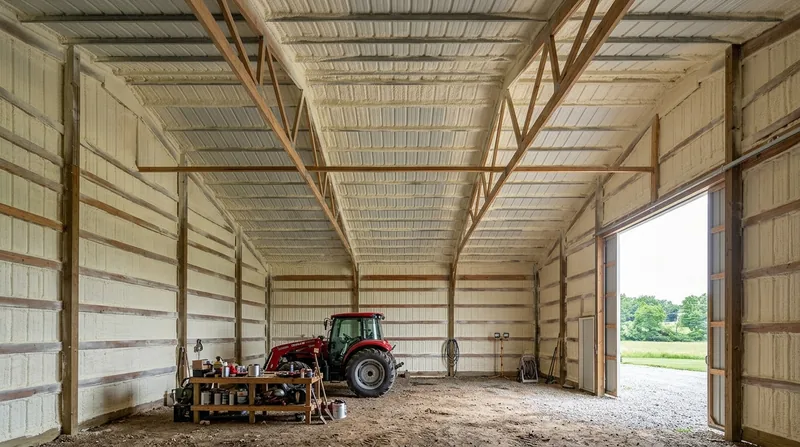




Pole barns, equipment sheds, ag buildings, and barndominiums across Greater Cleveland and Geauga County face a moisture problem that standard fiberglass insulation cannot solve. The steel frame of a post-frame structure sweats in spring when warm, humid air meets cold metal. By winter, frost forms inside. Metal building and barndominium spray foam seals that condensation at the source, and closed-cell foam does it better than any other insulation in the trade. From Medina and Lorain County farms to the industrial parks of Solon and Twinsburg, the failure mode is always the same: water vapor migrates into the cavity, condenses on steel, and rots wood and corrodes fasteners. We spray closed-cell foam directly onto the underside of the metal deck, creating an air-tight, vapor-impermeable envelope that stops the problem before it starts. This is not a cosmetic upgrade. It is the only reliable way to keep a metal structure dry year-round.
Why Metal Building and Barndominium Spray Foam Matters in Cleveland and Northeast Ohio
Northeast Ohio's climate is driven by Lake Erie. Wind off the water finds every gap in a metal structure. Spring thaw brings humidity that condenses inside uninsulated or poorly sealed metal buildings. Summer heat and humidity reverse the vapor drive. Winter lake-effect snow loads pile up, and ice dams form along uninsulated eaves. A metal building without proper air sealing and insulation becomes a condensation chamber. The roof deck sweats. Purlins rust. Wood blocking rots. Fasteners corrode and loosen. Equipment stored inside accumulates moisture. Hay, grain, or machinery degrades. The building envelope fails faster than it should.
Closed-cell spray foam solves this by creating a continuous, air-tight seal with high R-value and a vapor barrier built into the material itself. Unlike fiberglass batts or blown cellulose, closed-cell foam adheres to steel, fills voids around fasteners, and stops air infiltration. It does not absorb water. It does not settle or sag. It holds its R-value for decades.
- Closed-cell foam creates an air-tight seal that fiberglass batts cannot match, stopping condensation at the source.
- The material acts as both insulation and vapor barrier, eliminating the need for a separate poly sheet that tears and fails over time.
- Spray foam fills around purlins, fasteners, and irregular shapes, leaving no thermal bridges or gaps for moisture to migrate.
- Metal buildings insulated with closed-cell foam maintain interior temperatures more evenly, reducing the temperature differential that drives condensation.
- The seal prevents pest entry, dust infiltration, and air leakage that would otherwise compromise stored goods or equipment.
For a post-frame agricultural building, equipment shed, or barndominium in Medina, Lorain, or Geauga County, closed-cell spray foam is the standard solution to condensation and moisture damage.
Key info: Ohio's frost line runs 36 to 48 inches deep. Metal buildings built on concrete slabs or shallow footings experience ground moisture and capillary rise. Spray foam applied to the roof deck and perimeter walls stops vapor entry from below and from above, protecting the structure year-round.
For more on how closed-cell spray foam handles condensation control, see our page on closed-cell spray foam insulation in Cleveland.
How We Insulate Metal Buildings and Barndominiums in Cleveland and Northeast Ohio
Every metal building job starts with a site visit and a moisture assessment. We inspect the existing roof deck, check for rust, corrosion, or previous water damage, and confirm that the substrate is dry before we spray. If we find active leaks, standing water in the structure, or wet wood framing, we do not spray. We fix the moisture first or we walk away. Foam applied to a wet substrate fails. It does not cure properly, it traps moisture, and it becomes a liability. Once the substrate is confirmed dry, we determine the foam thickness and R-value required by your local building code, and we prepare the surface for adhesion.
We spray closed-cell foam in multiple passes, controlling the thickness per pass to ensure proper cure and density. The material is sprayed at the correct drum temperature and pressure ratio specified by the manufacturer. We do not rush the job. Once the foam is in place, we provide mechanical ventilation during cure. We state a re-entry window of 24 to 48 hours before the space is occupied or sealed. This is not a shortcut. It is the mark of professional installation.
- We visit the site, assess moisture, and confirm the substrate is dry before any foam is sprayed.
- We determine the R-value and thickness required by your local building code and the application.
- We spray closed-cell foam in controlled passes, maintaining proper drum temperature, pressure ratio, and material ratio.
- We provide mechanical ventilation during the cure process to manage off-gassing and ensure safe re-entry.
- We inspect the finished foam for consistency, coverage, and adhesion before we leave the site.
- We provide written documentation of R-value, thickness, and re-entry window.
A metal building in Strongsville or a barndominium in Medina insulated this way will resist condensation, maintain its envelope, and perform for decades.
Example: A 40-foot by 60-foot pole barn near Hudson used for equipment storage had frost forming on the interior roof deck every winter. We sprayed 2 inches of closed-cell foam onto the underside of the metal deck and applied foam to the band joist and rim board where the roof meets the wall frame. The interior temperature rose 10 to 15 degrees. Condensation stopped. The building stayed dry year-round.
For guidance on air sealing and its role in metal building performance, see our air sealing page.
Metal Building and Barndominium Spray Foam Methods and Approaches
| Approach | Description | Best For |
|---|---|---|
| Closed-Cell Spray Foam on Roof Deck | High-density closed-cell foam sprayed directly onto the underside of the metal roof deck in multiple controlled passes. Creates a continuous air barrier and vapor barrier. Typical thickness 2 to 4 inches for R-13 to R-26. | Post-frame barns, equipment sheds, and barndominiums where condensation control is the primary concern. Also used in commercial warehouse and industrial buildings with metal frames. |
| Closed-Cell Foam on Perimeter Walls | Closed-cell foam sprayed onto the interior face of metal wall panels or onto the band joist and rim board where the roof meets the wall frame. Stops lateral air infiltration and vapor migration from outside. | Ag buildings and equipment sheds in Geauga County and Lorain County where wind-driven rain and humidity are persistent. Also used in barndominiums where exterior wall insulation is required for living space. |
| Closed-Cell Foam in Rim and Band Joists | Foam sprayed into the rim joist cavity and around the band board where the metal frame or wood frame meets the concrete foundation. Seals the thermal break and stops air leakage at the perimeter. | Barndominiums and hybrid metal buildings with living space. The rim joist is often the single largest air leak in a metal structure. Closed-cell foam eliminates this thermal bridge. |
| Closed-Cell Foam in Stud Cavities and Walls | Foam injected or sprayed into existing wall cavities in barndominiums where interior framing is in place. Fills voids around fasteners, wiring, and plumbing without requiring wall demolition. | Barndominium retrofits and metal buildings being converted to living or working space. Injection foam allows cavity fill without opening walls. |
Metal Building and Barndominium Spray Foam Cost in Cleveland: What to Expect
Metal building and barndominium spray foam pricing depends on the area to be insulated, the R-value required by your local building code, substrate condition, and accessibility. Closed-cell foam typically starts at $1.75 per square foot for straightforward roof deck applications in Strongsville, Solon, or Medina, but that figure moves based on several real factors.
A simple post-frame barn with a clean, dry metal roof deck and easy spray access will fall toward the lower end of the range. A barndominium with interior framing, electrical and plumbing in place, multiple wall sections, and limited access to the rim joist will cost more per square foot because of the labor and equipment setup required. If the roof deck has rust, corrosion, or previous water damage, we may need to clean or prime the surface before foam can adhere. That adds cost. If the building is in a remote area of Geauga County or Lorain County and requires a long drive, fuel and crew time factor into the estimate.
We provide written estimates with R-value and thickness specified. We do not quote a price per board foot over the phone. Every metal building is different. The only way to get an accurate number is a site visit. We respond within 24 hours and the estimate is free and without obligation. Call us at (216) 465-0804 or visit our pricing page for a starting point and a sense of what drives cost up or down.
Permit and code requirements vary by city and township. Cleveland, Parma, Strongsville, and Solon each have their own building department and their own interpretation of the energy and building code. We help you understand what applies at your address. We do not pull permits. That is your responsibility and the building official's. We install according to code and provide documentation to support your permit application if needed.
What to Look for When Hiring a Spray Foam Insulation Contractor Near Cleveland
The spray foam market in Greater Cleveland is split three ways: local independent shops, out-of-state rig-and-run crews that spray a job in an afternoon and disappear, and national franchises. Each has a different approach and a different risk profile. When you are evaluating a contractor, there are concrete things to check.
Ask for an estimate that includes R-value and foam thickness in writing. If a contractor gives you a price without naming the R-value or the thickness in inches, walk away. That is the first sign of a shop that does not know what it is doing or does not want to be held accountable. Ask whether they provide mechanical ventilation during cure and what re-entry window they guarantee. If they promise immediate re-entry or say the smell will be gone in a few hours, they are cutting corners. Proper closed-cell foam installation requires 24 to 48 hours for cure. Demand a reference from a recent job in Cleveland, Lakewood, Parma, or Solon. Call that reference and ask whether they had any issues with smell, cure time, or performance after the job was done.
Verify that the contractor carries liability and property damage insurance and ask for a certificate naming your project. Do not accept a verbal promise. Ask about their experience with metal buildings and barndominiums specifically. A contractor who has done 50 attics but never sealed a metal roof deck is not your expert. Ask whether they handle permits or whether you are responsible for pulling them. Most jurisdictions in Greater Cleveland do not require a permit for spray foam insulation, but some do. Know your local rule before you hire.
- Request a written estimate with R-value and thickness specified in inches, not a generic price range.
- Ask for mechanical ventilation during cure and a stated re-entry window of 24 to 48 hours minimum.
- Call a recent reference from your city or nearby and ask about smell, cure time, and performance after installation.
- Verify liability insurance with a certificate of insurance naming your project as the insured.
- Confirm that the contractor has direct experience with metal buildings or barndominiums, not just attic foam.
- Clarify permit responsibility before you sign a contract, especially if your township requires a permit for spray foam.
We are fully insured and we provide written estimates with R-value and thickness. We use mechanical ventilation during cure and we guarantee a re-entry window of 24 to 48 hours. We have insulated metal buildings, pole barns, equipment sheds, and barndominiums across Cleveland, Geauga County, Medina, and Lorain County since 2012. If you want to talk through your project, call us at (216) 465-0804 or contact us for a free estimate.
Metal Building & Barndominium Spray Foam in Cleveland: Pricing Guide
| Service | Price | Details |
|---|---|---|
| Roof Deck Spray Foam (Closed-Cell) | Starting at $1.75/sq ft | Straightforward metal roof deck, clean and dry substrate, standard 2 to 4 inch thickness for R-13 to R-26 |
| Perimeter Wall and Rim Joist Foam | Starting at $2.25/sq ft | Band joist, rim board, and perimeter wall sections where access is limited or framing complexity requires precision placement |
| Barndominium Interior Wall and Cavity Fill | Starting at $2.50/sq ft | Closed-cell foam injected or sprayed into existing wall cavities, around fasteners and electrical, without demolition required |
| Full Metal Building Envelope (Roof and Walls) | On estimate | Complete insulation of roof deck, perimeter walls, rim joist, and thermal breaks requires site assessment for accurate pricing |
| Substrate Prep or Remediation | On estimate | Rust removal, corrosion treatment, or surface cleaning before foam application; cost depends on condition and extent of damage |
| Estimate and Site Visit | Free | No obligation, response within 24 hours, includes written quote with R-value and thickness specifications |
Indicative pricing, the exact cost depends on square footage, finish, and site access. Free personalized estimate within 24h at (216) 465-0804.


