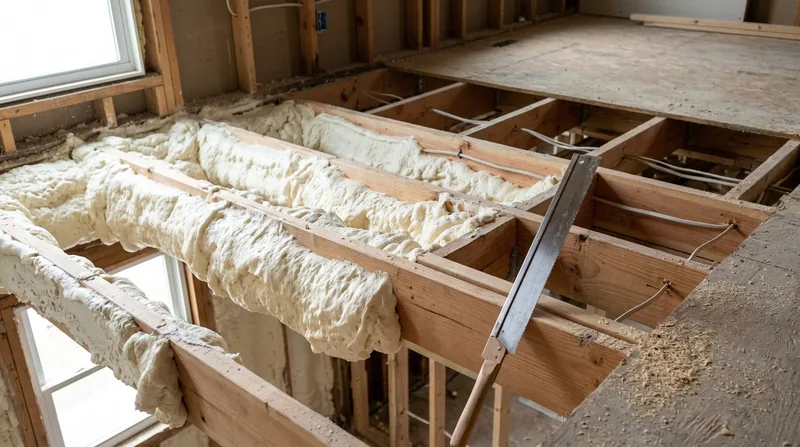




Open cell spray foam insulation in Cleveland is the affordable, sound-dampening answer for attics and walls in the city's densest neighborhoods. Cleveland's building stock spans a century of construction: balloon-framed doubles stacked two stories high in Ohio City and Tremont, Tudors and Colonials with full third-floor attics in Cleveland Heights and Shaker Heights, and 1940s-50s capes with knee-wall bedrooms in Parma and Euclid. Lake Erie drives the weather. Wind off the water finds every gap. Lake-effect winters run long and cold east of the city. Humid summers flip the vapor drive. Every assembly has to handle both seasons. Open cell foam at half a pound per cubic foot delivers R-3.5 per inch, costs less per board foot than closed cell, and cuts the sound transmission between the up and down units of a Cleveland double. We spell out where it belongs, and where a basement wall or a metal building calls for closed cell instead.
Why Open Cell Spray Foam Matters in Cleveland: The Ice Dam and the Double
Cleveland's attics fail in two ways. Ice dams form when lake-effect snow sits on an uninsulated or poorly insulated attic floor, the heat escapes upward, the snow melts at the roof deck, water backs up under the shingles, and it runs down the inside of the wall. The second failure is sound: a balloon-framed double in Tremont or Slavic Village has a shared wall between the up and down flats, and footsteps, voices, and plumbing noise travel straight through fiberglass batts and into the neighbor's bedroom. Open cell foam air-seals the attic floor and the rim, stops the heat leak that melts the snow, and damps the sound. The cost per board foot is lower than closed cell, and for an attic that does not need the moisture barrier of closed cell, it is the right call.
- Open cell foam expands to fill every cavity and seals air leaks that fiberglass misses, stopping the convection that carries heat to the attic floor in winter.
- The material absorbs sound between floor joists and rim joists, reducing noise transmission in multi-unit buildings and attached homes.
- At half a pound per cubic foot, open cell is lighter than closed cell and does not create vapor barriers that trap moisture in cold attics.
- The cost per board foot is 30 to 40 percent lower than closed cell, making a full attic retrofit affordable on a modest budget.
- Open cell cures quickly and off-gasses in 24 to 48 hours with mechanical ventilation, so the attic is usable again in two days.
Choosing the right foam type for your home depends on the assembly, the climate load, and the failure mode you are trying to stop.
Key info: A Cleveland double in Ohio City with an uninsulated attic floor and fiberglass batts in the rim joist loses heat through both, forms ice dams every January, and transmits footsteps from the upstairs flat to the living room below. Open cell foam on the attic floor and in the rim stops the ice dam and cuts the noise. The same foam in a basement wall below grade, where moisture is constant, is the wrong choice. That calls for closed cell.
For more on the closed cell option and when it is the right call, see our page on closed cell spray foam insulation.
Ohio law requires that spray foam meet fire code. The Cleveland Division of Building and Housing enforces the Ohio Building Code. Before work begins, verify with your local building department whether a permit is required and whether a thermal barrier (half-inch drywall or equivalent) must be installed over the foam. The fifteen-minute thermal barrier rule is the distinction most contractors misunderstand, and naming it correctly is itself the expertise signal. Your building official will tell you which applies at your address.
How We Install Open Cell Spray Foam in Cleveland Attics and Walls
Open cell spray foam installation starts with a site walk. We measure the attic floor or wall cavity, note the depth of existing insulation, check for air leaks around the rim joist and band joist, and identify any moisture or ventilation issues. We remove any failed or settled fiberglass, vacuum the substrate clean, and seal the larger air gaps with blocking or caulk. We then rig the spray rig, set up mechanical ventilation to exhaust isocyanate vapor during the cure, and spray the foam in two or three thin passes to build thickness without sagging. The crew stays on site until the foam is tack-free, typically four to six hours, and we provide a re-entry window of 24 to 48 hours before the attic is safe to walk on. A written estimate includes the R-value per inch, the target thickness, the total board feet, and the final price.
- We inspect the attic floor, rim joist, and walls to identify air leaks, existing insulation condition, and any moisture or ventilation issues.
- We remove settled or failed fiberglass batts and blown-in insulation, vacuum the substrate, and block large gaps to prevent foam from running into cavities.
- We rig the spray rig, set up mechanical exhaust ventilation, and confirm the drum temperature and mix ratio match the manufacturer spec.
- We spray open cell foam in two or three thin passes to build the target thickness, working from the eaves toward the ridge or from the sill toward the top of the wall.
- We trim excess foam flush with the framing, install any required thermal barrier, and provide a written re-entry window and care instructions.
The entire process from arrival to final trim takes one day for a typical 1,200-square-foot attic.
Example: A 1920s colonial in Shaker Heights with a 2,400-square-foot attic under a slate roof and two feet of settled fiberglass calls for 4 inches of open cell foam on the attic floor and 2 inches in the rim joist. The total is roughly 1,000 board feet. At a market rate of $0.55 to $0.70 per board foot, the job runs $550 to $700 in material plus labor. The ice dams stop. The upstairs bedroom stays 15 to 20 degrees warmer on a January night. The crew is off site by afternoon.
For a full walkthrough of the attic insulation process, see our attic spray foam insulation page.
| Approach | Description | Best for |
|---|---|---|
| Open Cell Attic Floor | 3 to 5 inches sprayed directly on the rim and attic floor joists, sealing all air leaks and providing R-10.5 to R-17.5. | Unvented attics, ice dam prevention, sound dampening in doubles, retrofit over settled batts. |
| Open Cell Rim Joist | 2 to 3 inches sprayed in the rim and band joist cavity, filling the gap between the rim board and the rim band. | Basement rim leaks, cold first-floor corners, sound transmission in attached homes. |
| Open Cell Wall Retrofit | 2 to 3 inches injected into closed wall cavities via small holes, expanding to fill the space and sealing air leaks in pre-1980 stock. | Interior wall insulation without demolition, sound dampening in shared walls, retrofit of balloon-framed doubles. |
| Open Cell Garage Ceiling | 2 to 3 inches sprayed on the underside of garage roof joists or on the ceiling above the garage, sealing the thermal boundary. | Attached garages, bonus rooms above garages, sound reduction in two-story structures with garages below. |
Open Cell Spray Foam Insulation Cost in Cleveland: What to Expect
Open cell spray foam costs starting at $0.55 per board foot in the Cleveland market, with most jobs landing between $0.55 and $0.75 per board foot depending on access, thickness, and the size of the job. A 1,200-square-foot attic requiring 3 to 4 inches of foam runs roughly 600 to 800 board feet, or $330 to $600 in material. Add labor, equipment, and the time to set up ventilation and trim, and a complete attic retrofit typically costs $1,200 to $2,500. A rim joist or garage ceiling is smaller and cheaper. A wall injection retrofit in a pre-1980 double is a mid-range job. The final price depends on how thick the foam needs to be, how much existing insulation you want removed, whether the substrate is clean and dry, and how easy the crew can access the space.
Getting two or three written estimates is smart. Each should spell out the R-value per inch, the target thickness in inches, the total board feet, and the labor cost. Estimates with no specs, no thickness, and a price far below market are a red flag. A contractor who promises to spray immediately without checking for moisture, who offers no mechanical ventilation during cure, or who says you can re-enter the attic in four hours is cutting corners. Spray foam cures in 24 to 48 hours with proper ventilation, and any estimate that skips that window is not being honest about the product.
For detailed pricing on all our services and a breakdown of what moves the cost up or down, visit our pricing page.
What to Look for When Hiring an Open Cell Spray Foam Contractor Near Cleveland
Spray foam work is not licensed in Ohio, but the contractor must be fully insured. Ask for proof of general liability and workers compensation insurance, and verify the policy is current. A contractor who cannot show you a certificate of insurance is not worth the risk. Second, ask for three references from jobs completed in the last two years in your neighborhood. Call them. Ask whether the crew showed up on time, whether they protected the house from overspray, whether the smell was manageable with the ventilation window they gave, and whether they have been reachable if questions came up later. Third, understand that your city may require a permit. The Cleveland Division of Building and Housing, Lakewood, Parma, Cleveland Heights, Shaker Heights, and other municipalities each have their own rules. Some require a permit for attic work. Others do not. Some require a thermal barrier over the foam. Your local building department will tell you what applies at your address. A contractor who says he will pull all permits is either lying or he does not understand that the rules change from city to city. The honest answer is that we help you navigate what applies at your address, we work with your building department if a permit is required, and we install the thermal barrier if the code calls for it.
- Verify the contractor carries current general liability and workers compensation insurance and provide a copy of the certificate before work begins.
- Ask for three recent references from jobs in Cleveland, Lakewood, Parma, or your neighborhood, and call them to ask about timeliness, cleanliness, smell management, and follow-up service.
- Check with your local building department to learn whether a permit is required for attic or wall work at your address and what thermal barrier rules apply.
- Get a written estimate that includes the R-value per inch, the target thickness, the total board feet, and the labor cost, and never accept a price with no specs.
- Ask how the contractor will manage isocyanate vapor during cure and what re-entry window he is guaranteeing, and reject any estimate that promises you can use the attic in four hours.
The difference between a local independent contractor and a rig-and-run crew from out of state is accountability. We are here. We have a local address and local plates. You can reach us if the smell does not clear, if the foam does not cure the way you expected, or if a question comes up six months later. Call us for a free estimate at (216) 465-0804 or contact us online.
Open Cell Spray Foam Insulation in Cleveland: Pricing Guide
| Service | Price | Details |
|---|---|---|
| Open Cell Attic Floor | Starting at $0.55/board ft | Includes removal of settled fiberglass, substrate prep, foam application at 3 to 5 inches, and labor. Larger attics and deeper foam increase total board feet and final price. |
| Open Cell Rim Joist and Band Joist | Starting at $0.55/board ft | 2 to 3 inches sprayed in the rim cavity, sealing the thermal boundary between basement and first floor. Smaller area than attic, so total cost is typically $400 to $800. |
| Open Cell Wall Injection Retrofit | Starting at $0.65/board ft | Injection foam in closed wall cavities of pre-1980 homes, no demolition required. Cost depends on wall height, cavity depth, and number of holes drilled. Typical job runs $600 to $1,500. |
| Open Cell Garage Ceiling | Starting at $0.55/board ft | 2 to 3 inches on garage roof joists or ceiling above garage. Smaller footprint than attic work, typically 300 to 500 board feet and $165 to $350 in material plus labor. |
| Estimate and Consultation | Free | Written estimate includes R-value, thickness, board feet, and labor cost. Response within 24 hours at (216) 465-0804. No obligation to book after estimate is provided. |
Indicative pricing, the exact cost depends on square footage, finish, and site access. Free personalized estimate within 24h at (216) 465-0804.


