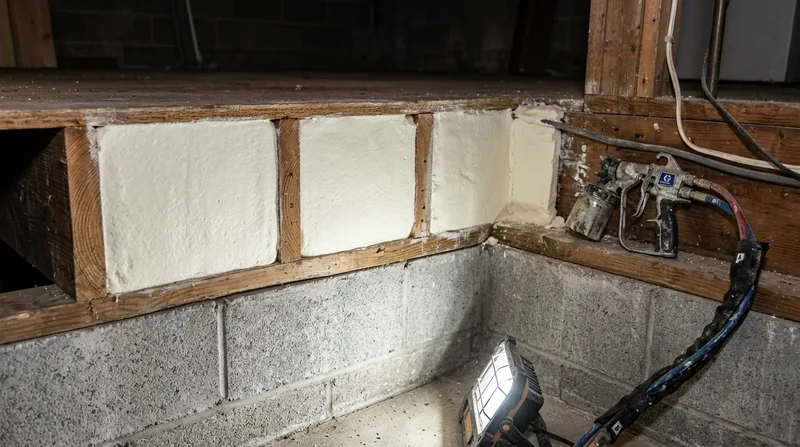




Basement rim joists are the hidden energy leak in almost every Cleveland house. Cold air pours in around the foundation rim, the band joist, and the rim header where your basement wall meets your house frame. In winter, that uninsulated rim can be 20 to 30 degrees colder than the rest of your basement, and the thermal bridge pulls heat straight out of the rooms above. Rim joist and band joist spray foam seals every bay along the foundation in a single pass, stops the air leak, and delivers the fastest comfort payback of any basement insulation job. We've been sealing rims in Cleveland, Lakewood, Parma, and the Heights since 2012, and we know the difference between a sandstone foundation that needs to breathe and a concrete block wall that can take a full closed cell seal.
Why Rim Joist Insulation Matters in Cleveland: Stop the Cold at the Foundation
Cleveland sits on Lake Erie, and the wind off the water finds every gap. Your basement rim joist is the perimeter where your wood frame sits on top of your foundation wall, and it is almost never insulated. In January, when lake-effect snow piles up and the wind comes off the water, that rim becomes a thermal sieve. The floor above it stays cold, the basement stays damp because cold air carries moisture, and you run your heat harder than you need to. Closed cell spray foam seals the rim and the rim header in one operation, stops the air leak, and eliminates the condensation that comes with it.
- A sealed rim joist stops cold air from flowing up into the walls and floors above your basement.
- Closed cell foam creates an air barrier and a vapor barrier at the same time, which is why it works on rim joists.
- On old sandstone foundations, we size the pass so the stone can dry to the inside, preventing moisture traps.
- The job takes one day, and the comfort payback is immediate: the rooms above the basement are noticeably warmer.
- Rim joist spray foam is one of the lowest-cost ways to improve basement comfort and reduce heating load in winter.
A sealed rim joist also reduces the amount of outside air that enters your basement, which means less humidity and less mold risk when the weather turns damp in spring.
Key info: In Cleveland Heights, Shaker Heights, and the older neighborhoods along the Cuyahoga valley, many homes sit on Berea sandstone foundations from the 1910s and 1920s. These foundations are porous and need to dry. We apply closed cell foam in thin, measured passes so the stone stays functional and the rim seals without trapping moisture inside the wall.
For more information on how air sealing works throughout your home, see our air sealing service page.
How We Seal Your Rim Joist: The Process from Estimate to Cure
Rim joist sealing is straightforward, but it has to be done right. We start in your basement and work bay by bay along the rim, applying closed cell foam to fill the gap between the top of your foundation and the rim header above it. We measure the thickness on each pass, control the ratio of the two-part foam, and keep the basement ventilated during cure so the foam hardens properly. Once cured, the foam is solid, does not shrink, and does not off-gas. The whole job is done in a day, and you can re-enter the basement after 24 to 48 hours.
- We inspect the rim and the rim header to identify all the bays and measure the depth of each one.
- We set up mechanical ventilation in the basement to move fresh air during the cure cycle.
- We apply closed cell foam in controlled passes, checking thickness and density as we go.
- We allow 24 to 48 hours for full cure before you resume normal use of the basement.
- We provide a written estimate with R-value and thickness specs before we start any work.
The whole process is clean and contained to your basement. We protect your floor, your furnishings, and your mechanical systems, and we leave the space ready to use once the cure window closes.
Example: A 1,200-square-foot ranch in Parma with a full basement and a rim that runs the perimeter takes one day. We seal 120 linear feet of rim joist, apply closed cell foam to R-19 minimum, and the homeowner sees a 10 to 15 degree difference in the first floor temperature within the first week of winter.
If your basement also has crawl space sections or a partial crawl, we can seal those at the same time.
Rim Joist Spray Foam Methods: Closed Cell vs. Other Approaches
Rim joists are small, tight spaces, and the insulation method has to work in that geometry. Closed cell foam is the standard because it seals air and moisture at the same time, and it does not settle or compress over time. Fiberglass batts or blown-in cellulose do not seal the air gaps, and they absorb moisture from the basement air. Open cell foam is too permeable for a rim joist in Cleveland's humid climate. Closed cell is the answer, and the thickness and R-value are sized to your foundation type and your basement conditions.
| Approach | Description | Best for |
|---|---|---|
| Closed Cell Spray Foam | Two-part polyurethane foam, 1.5 to 2 lb density, R-6.5 per inch. Seals air and vapor in one pass. Cures hard and does not settle. | Standard rim joist sealing in Cleveland. Works on concrete block, poured concrete, and sandstone. Handles basement humidity. |
| Closed Cell on Sandstone | Same foam, applied in thinner passes so the stone can dry to the interior. Measured thickness and careful ventilation prevent moisture traps. | 1910s to 1930s homes in Cleveland Heights, Shaker Heights, Tremont, and Ohio City. Preserves the foundation while sealing the rim. |
| Fiberglass Batts | Standard insulation batts, R-3.2 per inch. Does not seal air. Absorbs moisture and settles over time. | Not recommended for rim joists in Cleveland basements. Does not stop air leaks and fails in humid conditions. |
| Blown-In Cellulose | Recycled paper fiber, R-3.5 per inch. Settles and does not seal. Absorbs water from basement air. | Not suitable for rim joists. Settles away from the rim header and loses effectiveness in winter and spring. |
Closed cell spray foam is the only method that seals the rim joist and keeps it sealed. Fiberglass and cellulose are cheaper upfront, but they do not stop air leaks and they absorb moisture, so they fail in Cleveland basements within a few years.
Rim Joist and Band Joist Spray Foam Cost in Cleveland: What to Expect
Rim joist spray foam in Cleveland starts at around $650 for a small basement section and scales with the linear footage of rim you have and the depth of the cavity. A typical 1,200-square-foot ranch with a full basement perimeter runs $1,500 to $2,500 depending on the foundation type, the height of the rim, and whether you have any obstructions like water lines or electrical conduit in the bays. A larger colonial or a two-story with a deeper rim and more linear footage can run $2,500 to $4,000. The main factors that move the price are the total linear feet of rim, the depth and width of each bay, and whether the foundation is sandstone (which requires more careful, thinner passes) or concrete block (which can take a full-thickness pass in one or two applications).
Getting multiple estimates is smart. A good estimate includes the R-value and the thickness you will receive, the number of passes, and the cure time. Avoid any estimate that does not specify these details or that quotes a price far below the market. Low-ball estimates often mean the job is rushed, the ventilation is skipped, and the foam is not applied to specification.
See our full pricing overview for more details on how we structure estimates and what factors affect the final cost.
Cost example: A 1950s brick bungalow in Parma with a full basement, 120 linear feet of rim joist, and concrete block foundation runs $1,800 to $2,100. A 1920s Tudor in Cleveland Heights with sandstone foundation, 150 linear feet of rim, and deeper bays runs $2,200 to $2,800 because the foam is applied in thinner, more careful passes to allow the stone to dry.
Rim Joist and Band Joist Spray Foam Near Me: What Cleveland Homeowners Should Know Before Hiring
Hiring a spray foam contractor for your rim joist is straightforward if you know what to look for. Start by asking whether the contractor is fully insured and can provide a certificate of insurance on request. Then ask for a written estimate that includes the R-value, the thickness of foam you will receive, and the number of passes. Ask whether they will provide mechanical ventilation during cure and what the re-entry window is. Call the local building department to find out whether a permit is required for rim joist sealing at your address (most do not require one, but some older neighborhoods have specific rules). Finally, ask for references from recent jobs in your neighborhood and call them.
- Verify that the contractor is fully insured and can show you proof of coverage before the work starts.
- Get a written estimate with R-value, thickness, and the number of passes the contractor will apply.
- Ask whether the contractor will set up mechanical ventilation during the cure cycle and what the re-entry time is.
- Check with your local city or township building department to confirm whether a permit is required at your address.
- Ask for at least two references from recent jobs in Cleveland, Lakewood, Parma, or your neighborhood.
- Avoid contractors who promise immediate re-entry, quote a price far below market, or cannot provide a written estimate with specifications.
A contractor who takes time to understand your foundation, provides a detailed written estimate, and commits to proper ventilation and cure time is the contractor you want. Contact us for a free estimate and we will walk you through the whole process.
Rim Joist & Band Joist Spray Foam in Cleveland: Pricing Guide
| Service | Price | Details |
|---|---|---|
| Small rim section (under 60 linear feet) | Starting at $650 | Includes closed cell foam to R-19 minimum, mechanical ventilation, and 24 to 48 hour cure window |
| Standard basement rim (60 to 120 linear feet) | Starting at $1,500 | Full perimeter seal on a typical ranch or cape, concrete block foundation, includes all materials and labor |
| Sandstone foundation (1910s to 1930s homes) | Starting at $1,800 | Measured passes so stone can dry, takes longer, requires careful ventilation, typical Cleveland Heights or Shaker Heights job |
| Large or complex rim (over 150 linear feet, obstructions, multiple foundation types) | On estimate | Requires on-site inspection to measure all bays, check for water lines and conduit, and determine the best sealing strategy |
| Travel | Included | No separate charge for service calls in Cleveland, Lakewood, Parma, Heights, and surrounding areas |
| Free estimate | No charge | Response within 24 hours, written estimate with R-value and thickness specs, no obligation to book |
Indicative pricing, the exact cost depends on square footage, finish, and site access. Free personalized estimate within 24h at (216) 465-0804.


